Where to Take the Best Photos in Nice: The Most Beautiful Photo Spots
Categories : Nice, French Riviera, published on : 9/30/26
In Nice, light is part of the landscape. It reflects off the Mediterranean, brings out the warm ochre façades of the Old Town, filters through the arcades of Place Garibaldi and transforms the colours of the Port throughout the day.
Within just a few minutes’ walk, the scenery can change completely: from a narrow Old Town street to a panoramic view over the Bay of Angels, or from a colourful market to a harbour lined with boats. This variety makes Nice an especially photogenic city, whether you are travelling with a camera or simply using your phone.
But where are the best places to take photos in Nice? Which viewpoint offers the most beautiful panorama over the city? And where should you go for the best light at the end of the day?
From Castle Hill to Port Lympia, via Nice Old Town and the Mediterranean seafront, here are some of our favourite places to discover Nice through the lens.
Why is Nice so photogenic?
In Nice, the scenery changes without ever really leaving the city centre.
 Set between the Mediterranean and the surrounding hills, the city brings together remarkably different landscapes within a relatively compact area. The blue of the Bay of Angels contrasts with the warm façades of the historic centre, palm trees line the seafront just a short walk from the narrow streets of the Old Town, while the hills provide an entirely different perspective over the city.
Light also plays an essential role. Bright and contrasting around midday, it gradually softens as the sun gets lower, revealing the textures of the façades and creating reflections on the water.
Yet the photographs that capture Nice best are not always the most spectacular ones. A blue chair facing the sea, half-open shutters, a traditional fishing boat moored in the harbour, flowers at Cours Saleya or the shadow beneath an arcade can sometimes say more about the city than a postcard-perfect panorama.
Castle Hill, for panoramic views over Nice
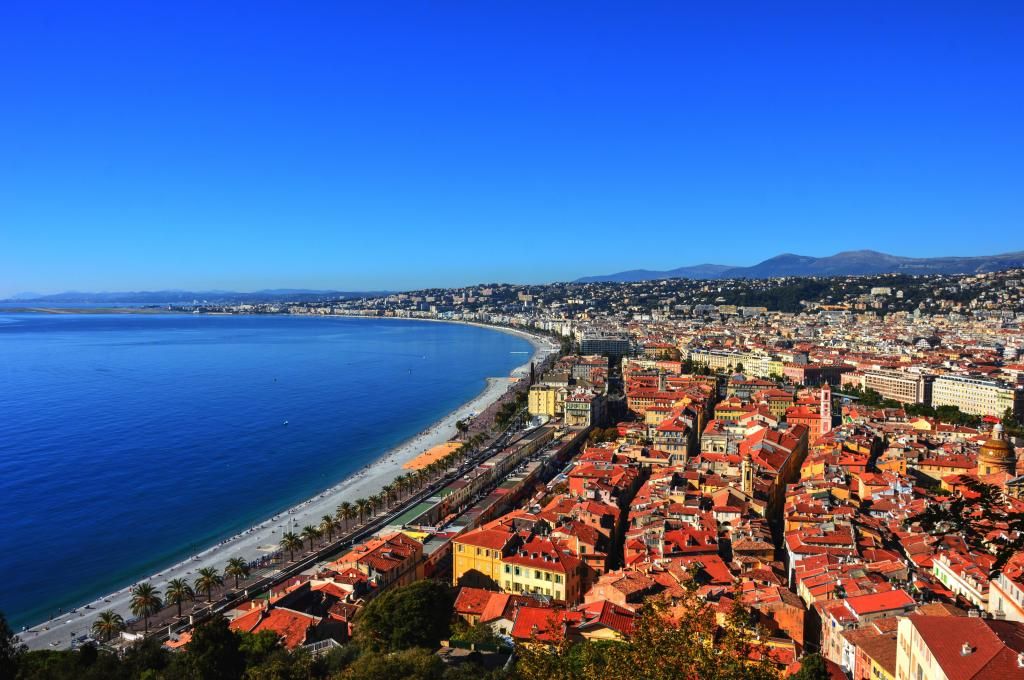
For a sense of Nice’s geography at a glance, Castle Hill — or Colline du Château — is an essential stop.
Located between Nice Old Town and Port Lympia, it offers several viewpoints across the city. Rising 92 metres above sea level, its belvedere overlooks the Bay of Angels, the city centre and the surrounding hills, while the other side of Castle Hill reveals views over the Port.
It is precisely this variety that makes the location so interesting for photography. From one side, the sweeping curve of the Bay of Angels stretches along the coastline. Change viewpoint, and Port Lympia and its colourful surroundings appear below.
There is more to photograph here than panoramic views. Inside the park, shaded pathways, greenery and the Cascade du Château waterfall provide a completely different setting.
Morning is ideal for a quieter atmosphere, while the end of the day generally brings softer light over the façades and the Mediterranean.
Nice Old Town, for colourful façades and narrow streets
In Nice Old Town, or Vieux-Nice, you rarely need to search for a photograph.
A sunlit ochre façade, half-open shutters, a wrought-iron balcony or a narrow street leading towards a church tower can be enough to capture the character of the neighbourhood.
Around Place Rossetti and along the small streets leading towards Cours Saleya, the light filters between the buildings differently throughout the day. One street may remain almost entirely in the shade while, just a few metres away, another façade suddenly catches the sunlight.
Remember to look up, too. Between the shutters, balconies and tall façades that almost seem to meet around a narrow strip of sky, interesting compositions appear naturally.
Rather than focusing only on monuments, look for architectural details and everyday scenes. They are often what best capture the atmosphere of Vieux-Nice.
Cours Saleya, for the colours of the market
Just a few steps away, Cours Saleya introduces yet another colour palette.
From Tuesday to Sunday, its famous flower market brings the Old Town to life in the morning. Flowers, fruit, vegetables and local produce fill the stalls, surrounded by the colourful façades and café terraces lining the square. On Mondays, the atmosphere changes as Cours Saleya hosts its antiques and flea market.
Morning is therefore an especially good time for photography.
Rather than always trying to capture the entire market, move closer. A bouquet of flowers, a display of citrus fruit, a shopfront or a basket of local produce can sometimes convey the atmosphere more effectively than a wide shot.
For a different perspective, head towards the top of the Ponchettes steps opposite Place Pierre Gautier, where you can look down over Cours Saleya from above.
Port Lympia, between traditional boats and colourful façades
At Port Lympia, the scenery changes once again.
Here, photography revolves around the water. Traditional Niçois fishing boats, known locally as pointus, bring splashes of colour to the harbour, while warm-toned façades surround the basin and are reflected in the water.
Simply walking a few metres along the quays can completely change the composition: traditional boats in the foreground, colourful architecture behind them, details of the vessels or a more open view towards the Mediterranean.
The Port is particularly photogenic when the sunlight becomes softer. Reflections become more visible on the water and the colours of the surrounding buildings take on a different quality.
For an image that feels distinctly Niçois rather than simply Mediterranean, look for the traditional pointus, details along the quays and the characteristic façades surrounding the harbour.
Place Garibaldi, for architecture, lines and arcades
Just a few minutes from both the Port and the Old Town, Place Garibaldi offers a completely different photographic setting.
Here, the eye is naturally drawn to lines, perspectives and architecture. The symmetrical façades and arcades give structure to photographs without requiring much effort.
Walk beneath the arcades and use them to frame the square. Depending on the time of day, the changing shadows also alter the appearance of the façades, allowing you to create very different images from the same location.
Place Garibaldi is also an excellent starting point for a photo walk through Nice: the Old Town and Promenade du Paillon lie in one direction, while rue Catherine Ségurane and Port Lympia are just a short walk away in the other.
Rauba Capeu and the Promenade des Anglais, Nice by the sea
At the foot of Castle Hill, Quai Rauba Capeu offers one of the most open views over the Bay of Angels.
From here, the eye naturally follows the curve of the coastline towards the Promenade des Anglais. The monumental #ILoveNice sign has become one of the city’s best-known photo landmarks, but walk just a little further away and you will find more natural compositions combining rocks, the Mediterranean and the horizon.
Continue along the seafront and you will reach the Promenade des Anglais.
Stretching for almost seven kilometres along the Bay of Angels, the promenade is lined with beaches, palm trees and Nice’s famous blue chairs.
Yet you do not need to photograph the entire promenade to capture its character. A single blue chair facing the sea, pebbles in the foreground, the shadow of a palm tree or simply the line of the horizon can create a far more personal image.
Towards the end of the day, Rauba Capeu and the Promenade des Anglais are also among the best places to watch the changing light over the Mediterranean.
Promenade du Paillon, for reflections and movement
Back towards the city centre, Promenade du Paillon provides a more contemporary backdrop.
Its large water mirror is ideal for playing with reflections of the sky and surrounding buildings, while the fountains add movement to photographs. Nearby, Place Masséna offers yet another architectural setting and a completely different range of perspectives.
After rainfall, or whenever the ground is still wet, remember to look down. Reflections can completely transform an otherwise simple composition.
This is also one of those places where some of the most interesting photographs happen almost by accident.
Rue Catherine Ségurane, a more intimate side of Nice
Less familiar to visitors than Cours Saleya or the Promenade des Anglais, rue Catherine Ségurane reveals a quieter side of Nice.
Leading naturally from Place Garibaldi towards the Port, the street passes through the city’s antiques district, at the foot of Castle Hill. The neighbourhood is known for its antique dealers, vintage objects and specialist shops.
Here, photography is less about sweeping panoramas and more about details: a shopfront, an old doorway, an architectural feature, an object spotted through a window or simply a moment of everyday neighbourhood life.
It is also at 22 rue Catherine Ségurane that you will find Palais Ségurane Boutique Hôtel.
From here, Place Garibaldi, Port Lympia, Nice Old Town and Castle Hill are all within easy walking distance.
What is the best time of day to take photos in Nice?
There is no single best time to photograph Nice — it depends on the atmosphere you are looking for.
Morning is particularly pleasant for exploring the markets, the seafront and the streets of Vieux-Nice before some areas become busier. Cours Saleya comes to life around its market stalls, while walkers, cyclists and runners are already enjoying the Promenade des Anglais.
Around midday, Mediterranean sunlight becomes stronger and contrasts more pronounced. This can work beautifully for bold colours, although shadows will also be much sharper.
By late afternoon, the atmosphere begins to change. The light gradually softens across the façades, while reflections become particularly attractive around the Port and along the seafront.
And once the sun has disappeared, do not necessarily put your camera away. Place Garibaldi, the Old Town and Port Lympia reveal a more urban atmosphere after dark.
A photo walk through Nice, entirely on foot
One of the great advantages of Nice is that you do not need a car to discover a wide variety of photographic settings.
From Palais Ségurane, begin on rue Catherine Ségurane and walk towards Place Garibaldi. From there, enter the Old Town and let its narrow streets lead you towards Cours Saleya.
Continue to Castle Hill for panoramic views over the city. Afterwards, walk down towards Rauba Capeu and follow the Mediterranean towards the Promenade des Anglais.
If you would like to extend the walk, head back around the other side of Castle Hill towards Port Lympia and finish the day along the quays.
In just a few hours, this route takes you from historic façades and colourful markets to panoramic viewpoints, the Mediterranean and the Port — all without needing a car.
A tip from Palais Ségurane
There is no need to rush from one landmark to another to photograph Nice.
Instead, choose a neighbourhood and take the time to notice the light, the façades and the small details around you. Nice is captured just as beautifully in a panoramic view as in a colourful doorway in the Old Town, a traditional pointu in Port Lympia, a bouquet at Cours Saleya or a blue chair facing the sea.
And do not hesitate to return to the same place at a different time of day. Under the morning sun or in the softer late-afternoon light, the same façade or landscape can look completely different.
From Palais Ségurane, many of these locations can easily be reached on foot. Take your camera — or simply your phone — and let the city decide where the rest of your walk takes you.
Stay close to Nice’s most photogenic places
Located at 22 rue Catherine Ségurane, between Port Lympia and Nice Old Town, Palais Ségurane Boutique Hôtel is an ideal starting point for exploring many of the city’s most photogenic places on foot.
After a day spent wandering between colourful streets, markets, panoramic viewpoints and the Mediterranean, return to the comfort of your suite in the heart of one of Nice’s most vibrant neighbourhoods.
FAQ
Where can you take the best photos in Nice?
Castle Hill is one of the best places to photograph Nice as a whole. For a variety of settings, Nice Old Town, Cours Saleya, Port Lympia, Place Garibaldi, Rauba Capeu and the Promenade des Anglais offer very different perspectives, from Mediterranean views and colourful façades to markets and historic architecture.
What is the best viewpoint in Nice?
Castle Hill offers one of the most iconic panoramic views in Nice. From its different viewpoints, you can look out over the Bay of Angels and the city centre, while the other side of the hill provides beautiful views over Port Lympia.
Where is the best place to photograph the sunset in Nice?
Quai Rauba Capeu and the Promenade des Anglais are particularly good choices towards the end of the day thanks to their open views over the Mediterranean. Castle Hill also offers beautiful panoramic views, although it is worth checking the park’s seasonal opening hours before planning a late visit.
Where should you take photos in Nice Old Town?
Cours Saleya, Place Rossetti and the narrow streets of the historic centre are particularly photogenic. Colourful façades, shutters, balconies, markets and small squares offer plenty of opportunities to capture the atmosphere of Vieux-Nice.
Can you visit Nice’s best photo spots on foot?
Yes. Nice Old Town, Cours Saleya, Place Garibaldi, Castle Hill, Rauba Capeu and Port Lympia are close enough to combine into a walking photo itinerary. Several of these locations are also within easy walking distance of Palais Ségurane.